
DIOCESE
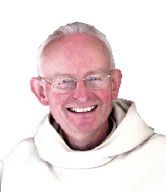
A Letter from Bishop Hugh Gilbert OSB
Dear Brothers and Sisters in Christ,
It is always a joy to celebrate the Assumption of Our Lady. This feast comes at the height of summer, when the harvest is being gathered and the Lord seems to crown the year with his goodness (cf. Psalm 65). Mary, the virgin mother of Jesus, is gathered body and soul into heavenly glory. In her we see the destiny prepared by God for his faithful people. She is a sign of sure hope and comfort for the pilgrim people of God.
DIOCESE
Annual Diocesan Pilgrimage to Pluscarden
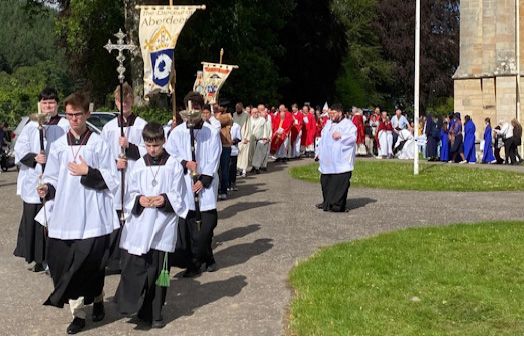
To report on this year’s Annual Diocesan Pilgrimage to Pluscarden, one could almost repeat what was written last year or the year before in this magazine. The format was the same; many or even most of the people involved were the same; the Feast was the same (St Peter and Paul, transferred to Sunday). As before, the whole organisation of the event was excellent, and as far as could be discerned, all went smoothly.
DIOCESE
Beauty for God — An Appeal to All in the Diocese, and Beyond
St Mary’s Cathedral belongs to all of us. As the mother church of our Diocese, it stands at the heart of Aberdeen as a place of prayer, welcome, and beauty. It belongs to every person in the diocese, to every parish, every community, and every person who walks through its doors. For generations, it has been a spiritual home for the faithful of the north east — a place where countless people have encountered God’s presence.
Latest Issue of the Light of the North ...
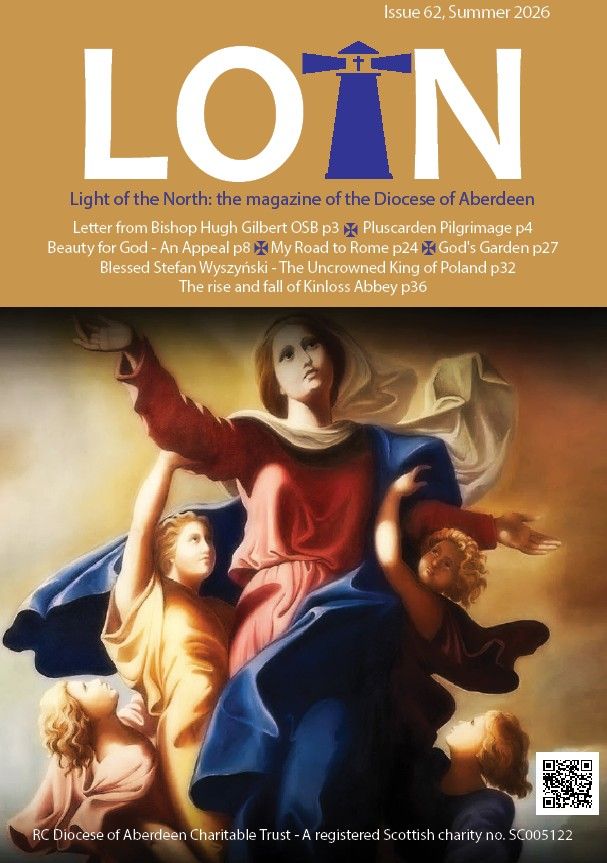
A Letter from Bishop Hugh Gilbert OSB
In a time of complexity, her simplicity refreshes us: “I am the servant of the Lord”. Amid so many threats to our humanity, she reminds us of the great opportunity of a Christ-full life which her Son has opened for us: “all generations will call me blessed”.
Our Lady is the chief patron of our diocese, and our Cathedral Church is dedicated to St Mary of the Assumption. The Cathedral is not simply a parish church in Aberdeen. It is the mother church of the Diocese, the place where the Bishop has his “chair”, the focal point of our common worship and communion. Whether we live in the city or the shires, in the Highlands, on the coast or in the islands, the Cathedral belongs to us all.
For this reason, I would like to draw your attention to the “Beauty for God” project, now entering its major phase. The project seeks to renew and enrich the sanctuary of St Mary’s Cathedral so that it more clearly fulfils its deepest purpose: to draw minds and hearts towards God. As the Church teaches, our sacred buildings should be “worthy and beautiful”, signs that point beyond themselves to the realities of heaven. Through beauty, the Gospel can speak in a way that words alone cannot always manage.
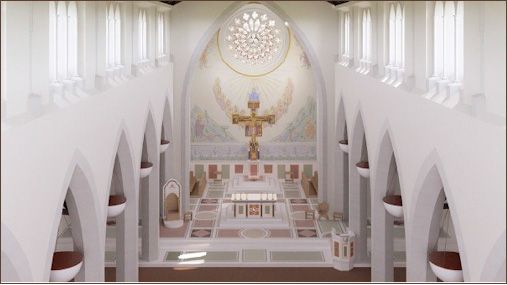
Many of you will already have seen the magnificent, suspended crucifix which now hangs above the altar. This was the first phase of the project and has shown its power to lift hearts. The second and final phase will bring together architecture, sacred art and craftsmanship in a way that enhances our liturgy and strengthens the Cathedral’s witness to its City and beyond for generations to come. The designs feature a mural to be painted on the East Wall, centred on an image of Mary, filled with the Holy Spirit and surrounded by the Apostles (See page eight).
What gives this project particular significance is that it has been conceived not merely for Aberdeen but for the whole Diocese. Stone and timber are being sourced from across the north of Scotland, from every corner of the Diocese. Different granites from around our territory will be incorporated into the work. In this way, the Cathedral will visibly express what it already is spiritually: a gathering point for God’s people across the Highlands, the islands and the north-east. It is my hope that every parish and every community will recognise something of itself in this work and feel represented within it. The Cathedral should speak of our shared faith, our shared history and our shared future.
The Feast of the Assumption reminds us that beauty matters. Mary’s life was beautiful because it was completely open to God. The Magnificat remains one of the most beautiful songs ever sung because it arose from a heart full of faith. Wherever God is welcomed, beauty follows. The Church has always sought to express this beauty through worship, music, architecture and art, not for their own sake, but because they help us glimpse the radiance of heaven and the presence of the Lord among us.
I have been privileged to serve this Diocese for 15 years now and I am conscious that each generation receives gifts from those who have gone before and is called to hand them on, enriched, to those who follow. The Cathedral we cherish today is itself the fruit of the generosity, sacrifice and vision of earlier Catholics, many of whom gave far beyond what was easy in order to create something lasting for the glory of God. We remain in their debt. Now the responsibility passes to us.
I am therefore much encouraged by the support already shown for this project. I am especially grateful to a benefactor whose remarkable generosity has made possible a matching-gift pledge of up to £300,000. Every donation received towards the project during this appeal will therefore be doubled in value, increasing both its impact and its significance for the future of the Cathedral and the Diocese.
Those who would like to learn more about the project, view the plans, or contribute to it can do so through the project website: https://beautyforgod.org/. As we celebrate Our Lady’s Assumption, I ask her intercession for every parish, every family and every person throughout the Diocese. May she help us keep our eyes fixed on her Son. May she teach us to recognise the beauty of holiness. And may she unite us ever more deeply as one diocesan family, journeying together towards the Kingdom where every earthly sign of beauty finds its fulfilment.
Yours devotedly in Christ,
+
Our Lady, assumed into heaven, pray for us.
Annual Diocesan Pilgrimage to Pluscarden
Nevertheless (maybe as usual, and maybe a bit subjectively, but): it really seemed as though this year’s Pilgrimage was the best ever!
Happily the sun shone warmly on the event. That certainly makes a big difference: especially for the family or parish groups picnicking in the grounds beforehand; for the many people going to confession outdoors, to one of several Priests positioned informally around the grounds; for the Marian procession and devotions after Mass; and for the wonderful festive atmosphere after all was finished, as folk gradually said their goodbyes before finally heading home. All, of course, to the sound of the pipes, with contributions too from the portable Nigerian and Kerelan percussion Orchestras!
Yes: it was a lot of work for those involved in the preparations, and also the clearing-up. And for many it was far to travel, both ways. But also: it was all uplifting and helpful and affirming and encouraging and wholesome and Catholic and good.
And surely this is as it should be, because although nothing was said publicly, nevertheless the presumption is that by this time next year Bishop Hugh, having reached the age of 75, will have been allowed to retire. So if all goes as he hopes, this would have been the last Pilgrimage at which he would officiate as our Diocesan Bishop.
To mention for this year in particular:
The service rendered by the teams from the Elgin parish was particularly outstanding. The refreshments tent; the stewards and first aid people; the servers. St Sylvester’s Catholic parish Elgin provided 12 of these. They were joined by several others from the diocese. All knew exactly where to go, what to do, when to do it and how. All had been thoroughly rehearsed: and their competent, dignified, unhurried and reverent serving significantly enhanced the solemnity of the occasion.
Once again this year we had some 600 people attending; more or less filling the two large marquees, as well as every available space in our very awkward Church. As before: various large flat screens and efficient sound systems were strategically placed, so that no one had to feel cut off from the liturgical action.
Our Elgin Dominican Sisters organised and led the hardy Pilgrims who chose to walk in from Elgin. These were, by the end, well over 30.
One of the deacons serving at the Altar this year was Revd René Delos Reyes. He had been at the Abbey on retreat the previous week: preparing for his ordination to the Priesthood for our diocese, to be held in Aberdeen Cathedral on 28th August.
The procession after Mass this year featured the whole of the Litany of Saints (sung in English) followed by the whole of the Litany of Our Lady (sung in Latin). We needed it all; not only devotionally, but simply to enable the many people, filing in procession from Church to garden, to be able to gather in time for the final prayers and blessing.
At the end of the Mass this year, and just before the procession started off, our Fr Joseph made a short speech, asking the attending Pilgrims to pray for vocations for our community. He noted that in four years’ time we will be celebrating 800 years of Pluscarden. We really don’t want the monastery to fall into ruin once again, this time simply for lack of young men coming forward to live monastic life… In function of this, everyone present received a tasteful card, with the text of a prayer for vocations to Pluscarden, as given below.
BY Fr BENEDICT HARDY OSB
Following the Lord wherever he leads
In 2025, the Cathedral completed the first step of a major artistic renewal: the installation of a double sided icon crucifix by Catholic artist Martin Earle. Suspended above the sanctuary, it strikes immediately all who enter and invites to prayer.
By supporting Beauty for God, you help create a sacred space that will inspire thousands: parishioners, pilgrims, students, families, and future generations who will look to the Cathedral as a place of beauty and encounter with God.
A Diocesan Family Working Together
Fundraising for the Beauty for God project began earlier this year during a quiet phase, as we approached a small number of potential lead donors. We were greatly encouraged by the generosity of a married couple whose significant early gift gave us the confidence to move forward with the appeal. As momentum grew, another generous donor met with Bishop Hugh and offered to match every remaining donation, pound for pound, up to a total of £300,000. This means that every gift you make, whether large or small, will have twice the impact. If you are a UK taxpayer, Gift Aid can increase the value of your donation by a further 25% at no extra cost to you. Alongside the generosity of individual supporters, we continue to seek grants from charitable trusts and foundations. Now, as we enter the public phase of the appeal, we warmly invite everyone to play a part in this once-in-a-generation project to preserve and enhance our cathedral for future generations. You may wish to make a gift in memory of a loved one. All donors, and those whose memory is honoured through a gift, will be remembered in a monthly Mass celebrated in the cathedral.
This project will create a sanctuary of profound beauty, crafted with traditional skills and materials from across the north of Scotland. It is an investment in our shared faith, our heritage, and the future of our Diocese. To learn more, view images, or watch the project presentation, please visit: www.beautyforGod.org
What your gift will help create
Your support will help realise:
• A renewed altar, ambo, and cathedra, (Bishop’s chair), designed to harmonise with the new artistic vision and enhance the Cathedral’s liturgy.
• A new tabernacle of wood, precious metal, and stone — the devotional centre of the Cathedral returned to the centre of the sanctuary.
• A monumental fresco on the East Wall, depicting Pentecost, the Assumption, and the heavenly Jerusalem.
• A new stone sanctuary floor, incorporating coloured granite from stone throughout the diocese –including Caithness, Orkney, and Shetland — symbolising the unity of our Diocese.
This project will enrich worship, welcome visitors, and strengthen the Cathedral’s role as a spiritual and cultural beacon for decades to come.
The Funding Need
• Total project cost: £685,094 (exc. VAT)
• Funds already raised: £135,000
• Matching pledge: Every remaining donation will be matched up to £300,000
Your gift today will unlock this matched funding and help us begin the physical works in 2027.
At the time of the first phase of the project Bishop Hugh wrote: “As human beings, we crave beauty, and we need to glimpse the beauty of God. I hope this sanctuary will lift the hearts and minds of all who worship here, and all who visit, and give them such a glimpse.”
The Cathedral is the spiritual home of our Diocese. It is where we gather for ordinations, diocesan celebrations, confirmations, pilgrimages, and major feasts. It is the church that represents us — our faith, our history, our hope.
By supporting Beauty for God, you help create a sacred space that will inspire thousands: parishioners, pilgrims, students, families, and future generations who will look to the Cathedral as a place of beauty and encounter with God.
How Parishioners Can Help
We invite every parish household to consider making a gift — whether modest or substantial. When many people give, even small amounts, the impact is extraordinary. And with matched funding, your gift today goes twice as far.
Donations can be made either directly by bank transfer to:
RCD Cathedral St Mary No.2 bank account
SORT CODE: 80-05-17 ACCOUNT NUMBER: 00759746
IBAN: GB58BOFS80051700759746 BIC: BOFSGB21351 or using the following QR code:

BY DEACON TONY SCHMITZ